Bramvia — Business Central Experts
Business Central vs NetSuite for US mid-market companies: an honest comparison (including where NetSuite wins)
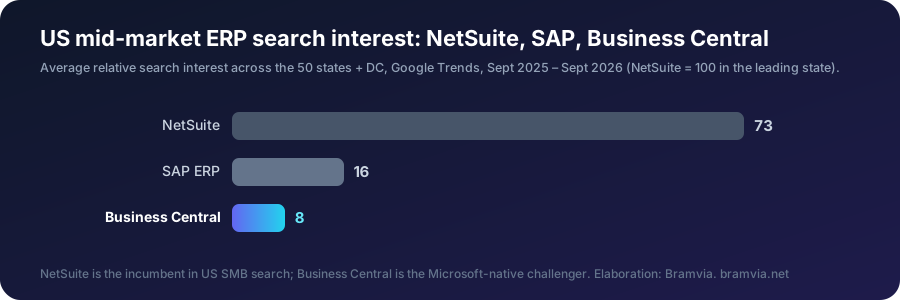
NetSuite dominates US SMB search interest; Business Central is the Microsoft-native alternative. Pricing model, implementation cost, Microsoft 365 fit, customization, AI, and the honest part: where NetSuite is the better choice.
Short answer: for a US company of 20-300 users choosing between the two, NetSuite is the more established cloud ERP in the US mid-market, with deep native financials, strong multi-subsidiary consolidation and a huge partner ecosystem — and a pricing model that grows with modules, users and annual uplifts. Business Central costs less to license and to implement, lives natively inside Microsoft 365 (Excel, Outlook, Teams, Power BI), is customized through extensions that survive updates, and ships AI agents that NetSuite is still catching up on. If your company runs on Google Workspace, needs sophisticated revenue recognition or SaaS billing out of the box, or is already a NetSuite shop that works, stay. If you run on Microsoft 365, have a warehouse or manufacturing, and care about total cost over five years, Business Central is the stronger case — written by a Business Central partner, with the NetSuite strengths stated first.
Where NetSuite wins
Financials for complex revenue. Multi-book accounting, revenue recognition (ASC 606), SaaS billing, subscriptions: NetSuite's finance depth is genuinely ahead out of the box.
Multi-subsidiary at scale. OneWorld consolidation across many entities and currencies is mature and widely used.
US mid-market mindshare. More US references, more US consultants, more integrations built with NetSuite in mind.
Single-vendor cloud. One platform, one contract — for companies that value that simplicity.
Where Business Central wins
Total cost. Licensing at $80-110 per user per month with no module add-on ladder for core ERP; implementations that typically land lower for comparable scope. NetSuite quotes are famously hard to compare — base platform, modules, users, and annual price uplifts at renewal.
Microsoft 365 fit. Excel connected live to the ledger, the customer card inside Outlook, approvals in Teams, and four Power BI apps included. If your company already lives in Microsoft, this is daily productivity, not a slide.
Customization that doesn't hold you hostage. Extensions in AL hook into the standard through events; two annual updates don't break them. NetSuite's SuiteScript customizations are powerful but accumulate technical debt many companies regret.
AI in production. Copilot included, plus payables, sales-order and expense agents with human-in-the-loop governance, billed by consumption. Business Central 29 (October 2026) unifies Copilot with Microsoft 365.
Manufacturing and warehouse in the base plan. Premium ($110) includes manufacturing and service; Essentials includes real warehouse management with lots and bins.
The comparison
| Dimension | NetSuite | Business Central |
|---|---|---|
| Ideal size | 50-1,000+ users | 10-500 users |
| Pricing model | Platform + modules + users, annual uplift | Per user, two plans, no module ladder |
| Financial depth (rev rec, SaaS billing) | Deeper out of the box | Good; advanced cases via apps |
| Multi-entity | OneWorld, mature | Native intercompany and consolidation |
| Office/productivity fit | Integrations | Native Microsoft 365 |
| Reporting | SuiteAnalytics | Power BI (4 apps included) |
| Customization | SuiteScript (powerful, debt-prone) | AL extensions (decoupled) |
| AI agents | Emerging | In production, consumption-billed |
| Updates | Twice yearly | Twice yearly, plus monthly |
| Implementation cost (comparable SMB scope) | Higher | Lower |
| US references | More | Fewer, growing (55,000+ cloud customers worldwide) |
How to decide
- Microsoft 365 or Google Workspace? Microsoft → Business Central multiplies value. Google → the gap narrows.
- Is your complexity financial (rev rec, subscriptions) or operational (warehouse, manufacturing, distribution)? Financial → NetSuite competes hard. Operational → Business Central.
- How do you feel about renewal-time price increases? If predictability matters, per-user pricing wins.
- Who implements it, and on what terms? The same product well and badly implemented gives opposite results. Insist on written acceptance criteria and milestone-based payment — our terms.
FAQ
Can we migrate from NetSuite to Business Central? Yes, and it is increasingly common when renewal pricing jumps or when a company standardises on Microsoft. Masters and balances migrate; history is archived. 3-6 months for a typical mid-size company.
Which is cheaper? For comparable SMB scope, Business Central — on licenses and usually on implementation. Compare five-year total cost including renewal uplifts, not year one.
What about QuickBooks? If you're outgrowing QuickBooks, both are candidates; here is when the move makes sense.
Do you work in Canada as well? Yes. Both products are available with Canadian localization; the comparison above holds, with GST/HST/PST handled natively by Business Central.
Do you implement in the US? From Europe, in English, for US companies — with a two-year US client reference available under NDA.
Choosing between the two? Free assessment, no commitment — and if NetSuite is the right answer for you, we'll say so.