Bramvia — Business Central Experts
Why your manufacturing jobs come in over estimate — and the quote-to-actual fix that stops it
If jobs consistently finish over the quoted cost, the quote is the problem, not the shop floor. Standard costs from 2022, yield that was never measured, setup time nobody records, and freight that moved 15% this year. How mid-market manufacturers close the gap between quoted and actual, one job at a time.
Short answer: when jobs consistently come in over the estimate, the shop floor is rarely the cause. The quote was built on numbers that were true once — standard costs set in 2022, a yield assumption nobody measured, setup time that doesn't get recorded, and freight that moved 15% this year — and every job inherits the error. The fix is not a better spreadsheet; it is a loop: quote → actual → variance → updated standard, per job, in the system, so the next quote learns from the last job. Mid-market manufacturers that close this loop typically find that a handful of products were quoted below cost for years, and that the fix pays for itself on the next quarter's quotes.
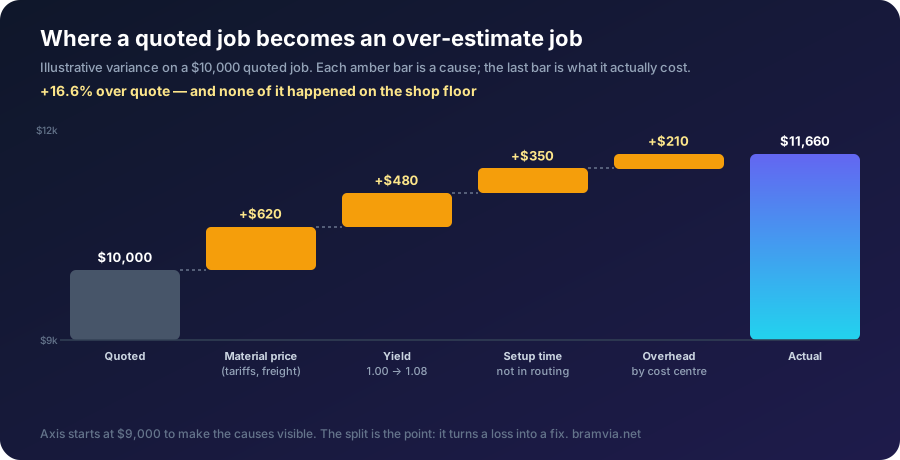
The four places the estimate goes wrong
1. Material costs that stopped being true. Standard costs are set once and reviewed rarely. Input prices moved hard through 2025-2026 — tariffs by country of origin, fuel surcharges, and freight that is up around 15% year on year. A quote built on last year's standard cost is wrong by exactly that much, before anything else goes wrong.
2. Yield that was assumed, not measured. The BOM says 1.00 kg per unit. Actual consumption is 1.08 because of scrap, trim and rework. That 8% is invisible until someone compares actual consumption per production order to the standard — and most companies don't.
3. Time nobody records. Setup, changeover, waiting for material, the operator who took ten minutes to find the drawing. Run time gets recorded; the rest gets absorbed. So the quote uses run time and the job costs run time plus everything else.
4. Overhead applied by habit. A flat percentage set years ago, applied to every job regardless of which machine, shift or cell it ran on. High-overhead work gets under-quoted and wins; low-overhead work gets over-quoted and goes to a competitor.
The loop that fixes it
Quote. Built from the current standard cost — material at today's landed cost, labour and machine time by routing, overhead by cost centre. Not a copy of the last quote for a similar job.
Actual. Every production order records what was actually consumed and how long it actually took. This is the part that requires discipline on the floor: material issued against the order, time posted against the operation. Barcode scanning makes it painless; paper makes it fiction.
Variance. Per job: quoted versus actual, split into material price, material usage, labour rate, labour efficiency, overhead. The split matters — "we lost $2,000 on this job" leads nowhere; "material usage was 9% over on operation 20" leads to the scrap on that machine.
Update. Variances that repeat become the new standard. If yield is consistently 1.08, the standard becomes 1.08 and the quote is honest. If setup on a family is consistently 40 minutes, it goes into the routing.
Run the loop monthly and the quotes converge on reality within a couple of cycles. Run it never and every quote carries the accumulated error.
What this looks like in the system
Business Central's manufacturing (Premium plan) does all four steps natively: BOMs and routings with standard costs, production orders with actual consumption and time, variance analysis by category, and standard cost update from actuals. What it needs from you is the floor discipline — consumption and time posted against the order — and a monthly review of the variance report.
Two things that make the floor part workable:
- Scanning. Issue material and post time from a handheld against the order. It takes seconds and it is the difference between data and guesses.
- Shop floor terminals showing the routing. The operator sees the operation, the expected time and the drawing. Recording actual time becomes part of finishing the operation, not a separate chore.
The uncomfortable finding
Most manufacturers who run this analysis for the first time find three to eight products quoted below true cost, sometimes for years, because the standard was optimistic and nobody compared. They also find products quoted well above cost that they've been losing on price — the mirror image, and just as expensive.
That list is worth more than the system. It is also what the Profit Leak Audit produces from your existing data, whatever ERP you run, before you commit to anything.
The formulas we use
The variance is only useful when it's split. These are the standard cost-accounting formulas, applied per production order:
Material price variance — did we pay more than the standard?
MPV = (Actual price − Standard price) × Actual quantity used
Example: standard $10.00/kg, paid $10.62 (tariff and freight), used 100 kg → +$62 unfavourable.
Material usage variance — did we use more than the BOM says?
MUV = (Actual quantity − Standard quantity allowed) × Standard price
Yield = Standard quantity allowed ÷ Actual quantity used
Example: BOM allows 100 kg, used 108 kg, standard $10 → +$80 unfavourable; yield = 100 ÷ 108 = 92.6%.
Labour efficiency variance — did it take longer than the routing?
LEV = (Actual hours − Standard hours allowed) × Standard rate
Example: routing 10 hours, actual 11.5 (setup not in routing), rate $60 → +$90 unfavourable.
Overhead variance
Overhead variance = Actual overhead applied − Standard overhead (standard hours × standard overhead rate)
Total job variance and the one number to report
Total variance = MPV + MUV + LEV + Overhead variance
Variance % = Total variance ÷ Quoted cost
Target: under ±3% on repeat work. Above ±8% consistently on a product means the standard is wrong, not the job — update it.
When to update the standard
If the same variance sign appears in 3 consecutive periods → new standard = actual average of those periods
FAQ
We don't have routings — we quote from experience. Then the experience is the standard, and it can still be recorded: expected hours per operation, expected material. Start there; the loop refines it.
Our jobs are all different — no two are alike. Then you quote at operation level, not product level: this cutting operation costs X per hour, this material costs Y per kg. Bespoke work is exactly where quote-to-actual matters most, because there is no repeat to learn from.
How long to set up? The system part is weeks. The floor discipline is the project — usually one cell or one product family first, then the rest once people see the variance report.
Do we need Premium? For production orders, routings and variance, yes. If you assemble to order without routings, Essentials with assembly orders covers simpler cases.
Jobs finishing over estimate and nobody can say why? Free assessment, no commitment — we'll look at your last quarter's jobs and tell you where the gap is.