Bramvia — Business Central Experts
Your warehouse runs on the memory of three people. Barcode scanning, directed picking and cycle counts fix that in 90 days
When warehouse turnover runs near 49% a year, knowledge that lives in people walks out twice a year. What a mid-market distributor actually needs — bins, scanning, directed put-away and picking, cycle counting instead of the annual shutdown — what it costs, and the order to roll it out without stopping shipments.
Short answer: most mid-market warehouses work because three people know where everything is. That is fine until one of them leaves — and with warehouse turnover running around 49% a year, they do. The replacement is not a "WMS project": it is four things, in order, that live inside the ERP you already run. Bin locations so every item has an address. Barcode scanning so movements are recorded when they happen, not remembered later. Directed put-away and picking so a new hire is productive on day two. And cycle counting so you stop shutting down for the annual count and start trusting the number. For a 5,000-SKU distributor this is a 90-day rollout, done one zone at a time, without stopping shipments.
What "runs on memory" actually costs
- Picking errors. Wrong item, wrong quantity, wrong lot. Each one is a return, a credit note and a customer who tells others. Manual picking typically runs 1-3% error; scanned, directed picking runs well under 0.5%.
- Search time. Half of a picker's day walking, and some of that walking is looking. Directed picking cuts the walk and removes the search.
- Stock nobody trusts. If the system says 40 and the shelf says 32, purchasing buys wrong, sales promises wrong, and the annual count becomes a reconciliation nightmare. Inventory nobody trusts is also where cash hides.
- Training time. Weeks for a new hire to learn where things are. With directed picking it is a day.
- The annual shutdown. Two days closed to count, and a number that is wrong again by February.
The four pieces
1. Bins. Every location gets an address: aisle, rack, shelf, position. Every item has a default bin. Fast movers near the dock; slow movers up high. This is data entry, not software — and it is the step people skip because it looks boring. Nothing else works without it.
2. Scanning. Handhelds (or phones with a scanning app) record receipts, put-aways, picks and shipments against the order, with a barcode on the item and one on the bin. The movement is posted when it happens. No clipboards, no end-of-day keying, no "I'll enter it later."
3. Directed put-away and picking. The system tells the worker where to put the received goods and, on the way out, walks them through the shortest path to pick an order — bin by bin, quantity by quantity, scan to confirm. A new hire follows the screen. The three people who know everything become supervisors instead of bottlenecks.
4. Cycle counting. Instead of counting everything once a year, count a few bins every day — fast movers monthly, slow movers quarterly. Discrepancies get found and fixed within weeks, not at year-end. After two cycles the annual count becomes unnecessary, and most auditors accept a documented cycle-count program in its place.
What it looks like in Business Central
All four are in the standard product — Essentials includes bins, warehouse documents, directed put-away and pick with the location configured for it, and physical inventory with cycle counting periods per item. What you add is the hardware (handhelds and printers) and a scanning app; several exist on AppSource, and for specific flows we build the extension.
No separate WMS, no integration to maintain, no second system of truth. For a distributor under roughly 50,000 lines a day, the built-in warehouse is usually enough. Above that, or with automation (conveyors, sorters), a dedicated WMS integrated by API is the conversation — and we'll say which side you're on.
The 90-day rollout, one zone at a time
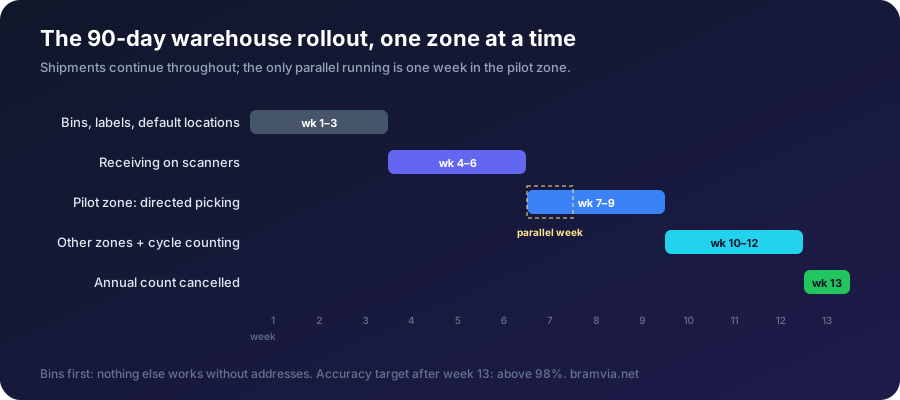
| Weeks | What happens | Shipments? |
|---|---|---|
| 1-3 | Bin layout designed and labelled. Items assigned default bins. Barcodes printed where missing. | Uninterrupted |
| 4-6 | Receiving goes to scanning first — it's the lowest-risk process and it fixes inbound accuracy immediately. | Uninterrupted |
| 7-9 | One zone moves to directed picking. Pickers trained on the screen. Errors measured before and after. | That zone only, one week of parallel |
| 10-12 | Remaining zones follow. Cycle counting starts on fast movers. | Uninterrupted |
| 13 | Annual count cancelled. Accuracy above 98% and climbing. | — |
The parallel week in the pilot zone is the only disruption, and it is one week for one zone.
What we'd tell you not to do
- Don't buy a WMS to fix a bin problem. If items have no addresses, no software fixes it.
- Don't scan without directed flows. Scanning that only confirms what the picker already chose adds work and removes nothing.
- Don't roll out everywhere at once. One zone, measured, then the rest. The pickers in zone two will ask for it after they see zone one.
- Don't skip labels. A warehouse where the barcode is on the paperwork but not on the shelf is a warehouse where scanning fails on the first bad day.
The formulas we use
Inventory accuracy
Inventory accuracy = Bins counted with correct quantity ÷ Bins counted
Target after directed picking and cycle counting: above 98%. Below 95% and purchasing is guessing.
Pick error rate
Pick error rate = Order lines with a picking error ÷ Order lines picked
Cost of errors = Errors × (Return shipping + Re-pick labour + Credit note handling + Lost margin)
Example: 12,000 lines a month, 2% error rate = 240 errors × ~$45 each = $10,800 a month. At 0.4% with scanning: $2,160.
Cycle count frequency (ABC)
Class A (top ~20% of items by value or movement): count monthly
Class B (next ~30%): count quarterly
Class C (remaining ~50%): count annually or on exception
Daily counts = (A × 12 + B × 4 + C × 1) ÷ Working days
Example: 5,000 SKUs → 1,000 A, 1,500 B, 2,500 C → (12,000 + 6,000 + 2,500) ÷ 250 days = 82 bins a day, about one hour. No annual shutdown.
Search and walk time
Walk share = Minutes walking and searching ÷ Total pick minutes
Manual warehouses typically run 50-60%. Directed picking with slotting (fast movers near the dock) brings it to 30-35% — the same people ship a third more.
FAQ
Our warehouse is small — 3,000 SKUs, six people. Then it's a 60-day rollout, not 90, and the payback is the same: errors, search time and the annual count.
We have lots and expiry dates. Exactly where this matters most. Directed picking enforces FEFO; manual picking enforces whatever is closest.
What does the hardware cost? Rugged handhelds run $1,000-2,500 each; phone-based scanning far less. For six pickers the hardware is a rounding error next to the error rate.
We're moving warehouses next year — should we wait? No. Do it now, and the move becomes a bin re-mapping instead of a chance to lose everything. Nearly a third of US manufacturers are adding warehouse capacity for reshoring; the ones with bins and scanning move cleanly.
Warehouse running on memory? Free assessment, no commitment — we'll walk it with you and tell you where to start.