Bramvia — Business Central Experts
Operating without AI in 2026: the silent cost that turns a competitive company into an obsolete one
One in five US businesses already uses AI, and 37% of firms with 250+ employees — up from under 4% in 2023 (Census Bureau). What happens inside a company that doesn't: more bureaucracy, slower decisions, expensive people on mechanical work, thinner margins. US data, real studies, the NAV deadlines, and what actually works.
Short answer: a company operating without artificial intelligence in 2026 is not "business as usual": it is losing ground at a measurable rate. One in five US businesses (19.8%) now uses AI in a business function; 37% of firms with 250 or more employees do, and 32% of those with 100-249 (U.S. Census Bureau, Business Trends and Outlook Survey, May 2026). Three years ago the national figure was under 4%. What happens inside the company left outside is neither dramatic nor visible in a quarter: it is bureaucracy nobody questions, month-end closes that take a week, expensive people doing mechanical work, errors that turn into credit notes, and decisions that arrive late. And there are dates. What works today will stop working in two years — not because AI is fashionable, but because competitors using it will produce the same output for less and faster, and because regulation pushes towards systems that already include it.
The map: where your company sits
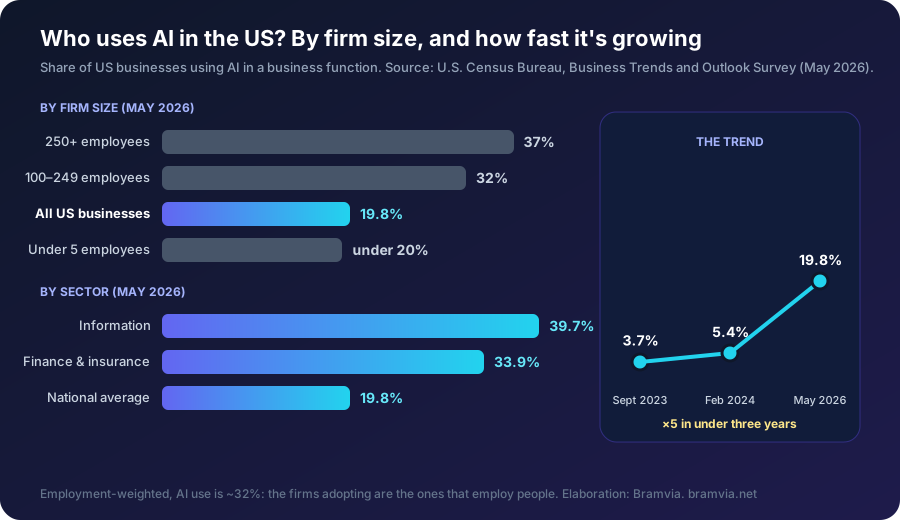
The Census Bureau's survey is the strictest measure there is — it asks whether a business used AI in a business function in the previous two weeks, not whether it plans to. On that measure, 19.8% of US businesses use AI. But the number that matters is not the average: it is size. Firms with 250+ employees are at 37%, those with 100-249 at 32%, and those with fewer than five employees stay under 20%. AI is entering from the top — and large companies are both the customers and the competitors of smaller ones. By sector, Information (39.7%) and Finance & Insurance (33.9%) roughly double the national rate.
Two nuances make the picture sharper. Weighted by employment, AI use is about 32%: the firms adopting are the ones that employ people. And the trend is not gradual — 3.7% in September 2023, 5.4% in February 2024, 19.8% in May 2026: a fivefold increase in under three years, with 20-23% of businesses expecting to use it within six months. The window to catch up is real. It is also closing.
What happens inside a company without AI
Not a collapse. An accumulation of small inefficiencies your competitors no longer carry.
1. Internal bureaucracy nobody questions. Vendor invoices someone types, matches to the order and routes for approval; customer orders arriving by email and copied by hand; expenses chased over WhatsApp. Each of those is already handled by a Business Central agent in production, under human supervision. In the company without AI, they are still jobs — and bottlenecks.
2. Slow decisions. A month-end close that takes a week means management sees July's margin in late August. The company with automated reporting and agents capturing 80% of invoices sees it on the 3rd. Deciding a month late on pricing, purchasing or overdue customers has a cost that never shows up as a line in the accounts.
3. Expensive people on mechanical work. It is not that AI removes jobs: it is that qualified, costly people do mechanical work — clerks reconciling banks, salespeople typing orders, a controller rebuilding the same spreadsheet every Monday. When competitors free those hours, they either sell more or stop paying for them.
4. Errors that become money. An outdated price on an order, a duplicate invoice approved, an expired lot shipped. Automated validation removes most of them. Without it, each error is a credit note, a complaint or an inspection.
5. Talent that leaves. Good finance and IT people don't want to type. A company still offering mechanical work in 2027 will have more churn — and less capacity to adopt anything.
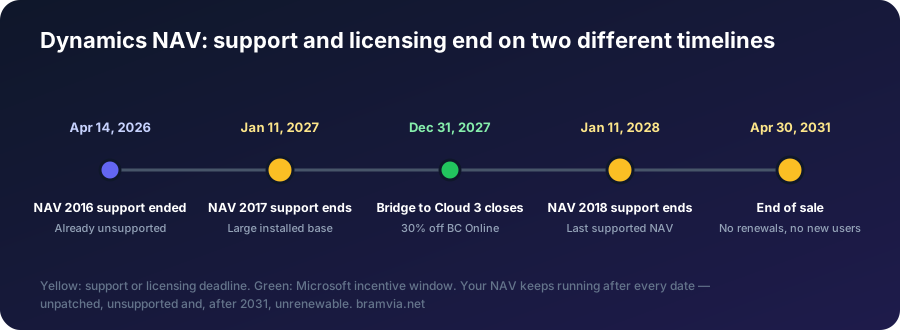
6. Compliance and platform deadlines. In the US there is no e-invoicing mandate forcing the issue — but there are dates all the same: Dynamics NAV 2017 loses support in January 2027, NAV 2018 in January 2028, and Microsoft stops selling NAV on April 30, 2031. The company without AI is usually also the company on an unsupported ERP, and the two problems have the same fix.
Real cases, with their caveats
The studies that measure the effect. In 2023, an experiment with 5,000 customer support agents (Brynjolfsson, Li and Raymond, Stanford/NBER) measured 14% higher productivity with AI assistance — and 34% among the least experienced: AI levels upwards. That same year, a Harvard/BCG study with 758 consultants found that, on suitable tasks, they completed 12% more work, 25% faster and with 40% higher quality. And a crucial caveat from the same study: on tasks outside AI's range, those using it performed worse. AI is not magic; it is a tool with a perimeter.
Klarna, the case that shows both sides. In 2024 it announced its AI assistant did the work of 700 support agents. In 2025 it acknowledged it had gone too far and rehired people for cases requiring judgement. The lesson is not "AI doesn't work": it is that AI with human supervision works, and AI without it eventually costs money. That is exactly the agent governance model Business Central ships today: the agent proposes, the person approves.
What we see in our own projects. In an environmental services company migrating from a 17-year-old NAV, transport documentation was produced by hand for every shipment; generated from the delivery note, that task disappears. In a chemical manufacturer, automated validation before submitting tax filings eliminated the rejections that used to be fixed one by one. And in the implementation itself we use AI to read old code, clean data and generate tests: fewer hours, fewer errors at go-live. Not brochure percentages — specific tasks that stop being done by hand.
What the ERP itself brings. Business Central includes Copilot in the license and payables, sales-order and expense agents billed by consumption — and version 29, in October, embeds them in daily work with human review on screen. For a smaller company, "adopting AI" is no longer a lab project: it is switching on what your system already ships.
Why what works today won't work in two years
Three forces push at once:
- Competition. AI use among US businesses went from under 4% to nearly 20% in under three years; large firms are already at 37%. Whoever produces at higher cost and slower doesn't lower prices: they lose customers.
- Platform deadlines. NAV support ends in 2027-2028 and sales in 2031; Business Central's AI features are cloud-only. The path off the old system and the path to AI are the same path.
- Customers. Large companies (37% with AI and climbing) demand EDI, portal integration, responses within hours and traceability from suppliers. A smaller company without a system to deliver that drops off the vendor list without anyone telling them.
What actually works in a smaller company (and it isn't "buying AI")
- One single, up-to-date system. Without a single source of truth there is no useful AI: agents work on orders, invoices and stock that live in an ERP, not in spreadsheets.
- Switch on what's included before buying anything. Copilot, the four Power BI apps, the payables agent on one specific, measured process.
- One process at a time, with supervision. Highest volume and lowest judgement first (vendor invoices, orders by email). Measure before and after.
- Humans in the loop. What Klarna learned the expensive way: AI proposes, someone approves. In Business Central that is configuration.
- Start now, not when "it matures". 60% in pilot means the advantage belongs to whoever reaches production first.
What AI does not fix
A bad process automated is a bad process running faster. A company with no owner for its data will not get useful AI. And no agent replaces the decision to stop selling to a customer who doesn't pay.
FAQ
Does a 15-person company really need AI? It needs to stop typing things twice and to stop closing the month in a week. If that is solved with a modern ERP and one agent on payables, then yes. If it is solved with better discipline and no AI, that counts too — the goal is cost and speed, not the label.
What does it cost to start? Copilot and Power BI are included in the license; agents are billed by consumption, with no new license. The real cost is having the system where AI can work.
What if my ERP has no AI? Then the question is what not having it costs you each year — and our ERP Health Check answers that in two minutes.
Will AI take my employees' jobs? It will take tasks. What you do with the freed hours — sell, serve, grow, or cut headcount — is a management decision, not a technology one.
Want to know which tasks in your company could already run themselves, and what they cost today? Free assessment, no commitment — with your company's numbers, not a report's.