Bramvia — Business Central Experts
ERP implementation with AI: faster, with fewer errors and at a lower cost
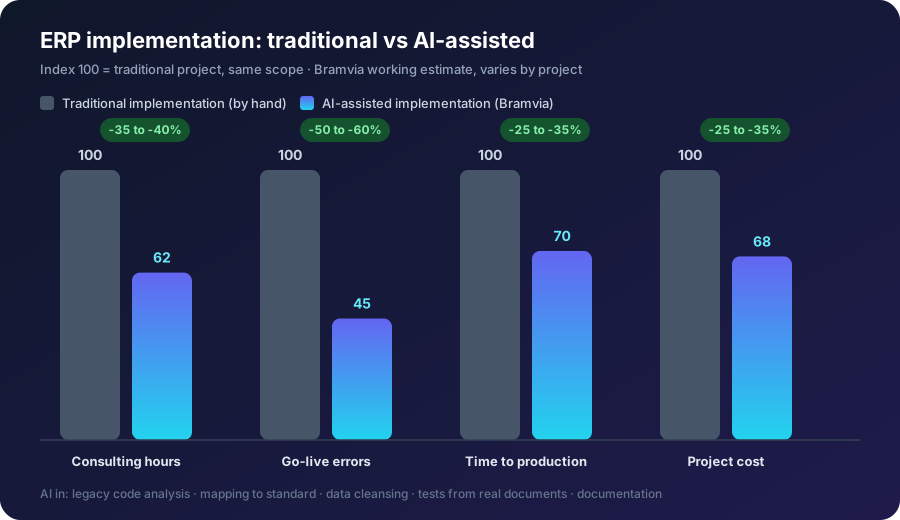
We apply AI at every phase of a Business Central implementation — legacy code analysis, data migration, testing, documentation — and those saved hours go into the price. With a chart: what changes and by how much, and where AI replaces no one.
Short answer: a traditional ERP implementation is, above all, consultant hours: reading old code, mapping processes, cleaning data by hand, writing test cases, documenting. We apply artificial intelligence to every one of those tasks from day one of the project — and we are among the few Business Central partners doing it systematically rather than as a demo. The result, in our working estimate: 35-40% fewer hours, half the errors at go-live, and 25-35% less time and cost for the same scope. That saving is not our margin: it is why we can quote below a partner working by hand without cutting anything — and why your project starts with improved processes instead of your old system's processes copied across.
Where AI comes in, phase by phase
1. Analysing the current system. A fifteen-year-old NAV has hundreds of customized C/AL objects nobody remembers the purpose of. AI reads them, groups them by function, detects which already exist as standard in Business Central and which are still needed. What used to be two weeks of a senior consultant reading code is now a complete inventory in two days — with fewer things to rewrite, because it finds overlaps with the standard that humans miss.
2. Process design — improved before go-live. Using your real data (orders, invoices, transactions from recent years), AI spots patterns: the 30% of orders passing through three unnecessary approvals, duplicate customers, flows that exist only because the old system forced them. The process is designed better at build time, rather than replicating the 2010 version. That is the difference between migrating an ERP and using the change.
3. Code conversion. Customisations that are genuinely needed are rewritten as AL extensions with AI assistance: the draft takes minutes, the consultant reviews, adjusts and tests. Fewer hours, and more consistent, better-documented code than what gets written by hand under deadline pressure.
4. Data migration and cleansing. Customer and vendor deduplication, address normalisation, item classification, detection of inconsistent records — before anything is imported. The line item that produces most surprises in any project becomes the most predictable one.
5. Testing with your real documents. AI generates test cases from your own historical invoices, orders and shipments — including the awkward ones — and runs them in the sandbox. That is why go-live has half the incidents: you test what actually happens in your business, not a demo.
6. Documentation and training. Role-based manuals, process guides and training material generated from the real configuration, in each user's language. What normally gets cut for lack of hours is included from day one.
7. After go-live. Business Central's AI agents — payables, sales orders — are switched on over a specific, measured process with defined governance.
Why this lowers the price without lowering quality
An implementation quote is mostly hours. If analysis, conversion, cleansing, testing and documentation consume 35-40% fewer hours, the project costs less for the same scope — and often for more scope, because documentation and thorough testing, which a hand-built project cuts first, are included here.
A partner working by hand cannot match that price without losing money or quietly cutting corners.
Where AI replaces no one
Being honest here is part of the method:
- Business decisions (which process to keep, which to drop, how to organise the warehouse) are made by your company with our consultant. AI prepares the analysis; it does not decide.
- Every output is reviewed — code, data, tests — by a person before it reaches your system. AI accelerates; it does not sign off.
- The relationship — understanding your business, listening to your users, managing change — remains human, and it is what decides whether an ERP is adopted or avoided.
The figures in the chart are our working estimate, not a fixed promise: every project is measured in the initial assessment, and hours and timeline are set part by part, with written acceptance criteria and payment only after you accept them.
FAQ
Does AI introduce bugs into the code? AI proposes; the consultant reviews and tests before deployment. AI-assisted code comes out more consistent and better documented than hand-written code under time pressure — and passes the same tests.
Is my data used to train models? No. Analysis runs with enterprise tooling under NDA; your data does not leave the project environment and trains nothing.
Is it cheaper because you work less? It is cheaper because mechanical tasks consume fewer hours. Consultant time concentrates on what adds value: understanding your business, deciding with you, reviewing.
Does it apply to a greenfield implementation, not just a migration? Yes — process design from real data and generated tests and documentation apply equally.
Want to know how many hours and how much time your project would save? Free assessment, no commitment.