Bramvia — Business Central Experts
Business Central 29 (October 2026): all 86 new features, explained for SMBs
BC29 reaches production in the first week of October with 86 new or improved features: unified Copilot, more capable agents, standard withholding tax, report packages, EDI via Peppol, Shopify B2B, quality and subcontracting. What matters, what is cloud-only, and what to do before it lands.
Short answer: Microsoft Dynamics 365 Business Central version 29 — 2026 release wave 2 — has been in public preview since early September and reaches production in the first week of October 2026. The official list adds up to 86 new or improved features. The ones that matter most to a smaller company: unified Copilot with the rest of Microsoft, a Payables Agent that matches invoices to orders more precisely, an Expense Agent with approvals and duplicate detection, withholding tax for vendors and employees in the standard, financial report packages delivered as a single scheduled PDF, EDI via Peppol for orders and payments, Shopify B2B, and quality and subcontracting improvements in manufacturing. And a reminder that carries weight: everything Copilot and agents is cloud-only.
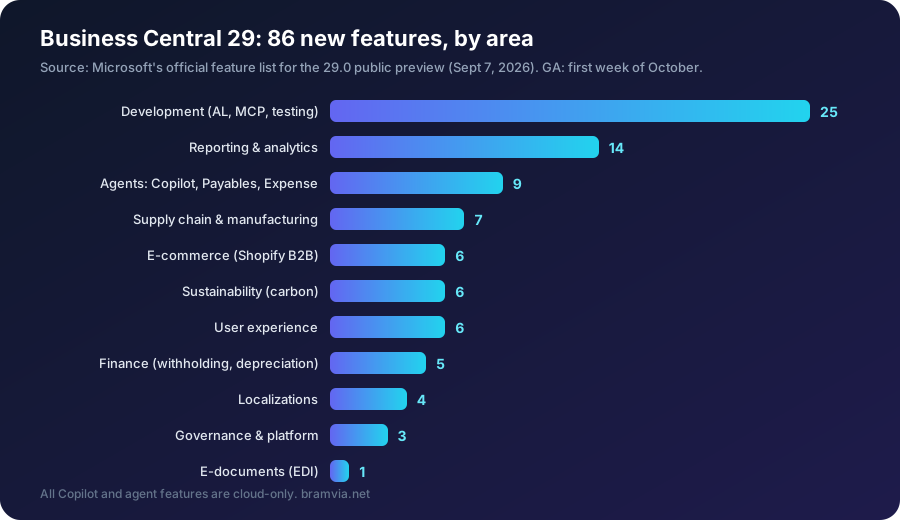
Where the weight of this release sits
The chart says it: almost a third of the new features are for developers (AL, MCP, automated testing, AI-assisted debugging) and another large block for reporting. That is no accident: Microsoft is turning Business Central into a platform where AI agents work over well-structured data and reports come out without development. You will notice it less on the day-to-day screen and more in what your partner can build and how fast a report appears.
Copilot and agents: what changes for the user
Unified Copilot. Business Central's chat becomes the same Copilot as Microsoft 365: it reasons over your business data, the web and general knowledge in a single conversation.
A sharper Payables Agent. It matches vendor invoices to orders using line amounts and expected receipt dates, and finalises drafts according to your receive-on-invoice setup. Less manual review in the most common case: an invoice that matches the order.
A mature Expense Agent. Approvals with AI policy validation (it flags suspicious lines), interim approver, duplicate detection even against already-posted documents, mileage by date and vehicle type, automatic withholding, and travel requests with multiple travellers.
Visible human control. A new review bar on lists and documents where an agent needs a person, agent permission management, and grouped avatars.
MCP for data queries. Applications connected via MCP can define, validate and run custom data queries, including over data without APIs.
Finance: three items that matter
- Withholding tax for vendors in the standard — and for employee transactions too.
- Accelerated depreciation of fixed assets with compliant calculation and reporting.
- Vendor-specific number series for self-billing: traceability and compliance in sectors that self-bill.
- Plus: multiple excise duties per item, and automatic change logging on financial reports (rows, columns, definitions) — auditing with nothing to configure.
Reporting: less development, more result
- Financial report packages: define a package with several reports and receive it as one PDF, scheduled, by email or in the report inbox.
- Report themes and reusable headers/footers: your documents with consistent branding, configurable per company, report or layout.
- Automate report output with new APIs over the report inbox: Power Automate or MCP can collect, distribute and archive reports.
- Bookmarks for list views and analysis tabs, audit fields in analysis mode, and account usage tracing in financial reports.
Supply chain and manufacturing
- Quality: closing an inspection auto-fills approved and rejected quantities; posting errors take you to the blocking inspection.
- Subcontracting: routing instructions and attachments flow to the subcontractor's purchase order; assisted setup; basic warehouse locations now support subcontracting.
- Direct transfers from locations with warehouse pick/ship.
Electronic documents and e-commerce
- EDI via E-Documents with Peppol BIS 3: electronic orders and payments through the same framework as e-invoicing.
- Shopify B2B: companies, catalogues and B2B pricing, a tax-matching agent, aligned exchanges/returns/refunds, and syncing of tariff codes and country of origin.
Platform: faster underneath
- A new data model for table extensions: all fields of a table, including extension fields, are stored in the same physical table. Every operation involving extensions is faster — with nothing to change.
- Administrators can enable or disable SIFT indexes from the application itself, and Excel exports are logged in telemetry.
- For developers: keys mixing base and extension fields, interfaces with default implementations, AL tests from the command line and CI/CD, and AI agents for debugging failed sessions and profiling performance.
A change of method: goodbye to release plans
From September 2026 Microsoft stops publishing Release Plans; new features move to the always-on "AI at Work roadmap". For you, "what's coming" is no longer a twice-yearly document but a living map — and it helps to have someone following it for you.
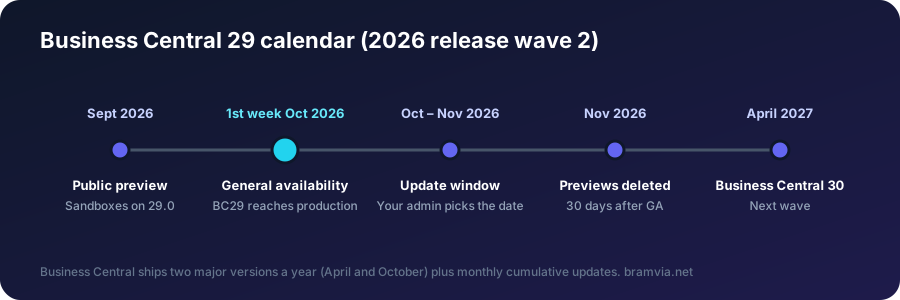
What to do before October
- Enable the preview in a sandbox (version 29.0 preview) and run your month-end close and your busiest order day. Microsoft deletes previews 30 days after GA.
- Test your extensions: the new table-extension data model is transparent, but any code depending on internal structures or direct SQL access deserves a pass. If your integrations use SOAP web services over pages, confirm their status — migrate to OData/APIs.
- Choose your update window in the admin center.
- Plan what to switch on first: the Expense Agent if your team travels, report packages if month-end is heavy, withholding if you pay professionals.
If you are on NAV or on-premises: none of this arrives. Each wave widens the gap; this one widens it more than the previous ones.
FAQ
When does BC29 reach my environment? General availability is the first week of October 2026; your administrator picks the date within the update window. Online environments update themselves; on-premises receives the version but not the AI features.
What do the new features cost? Nothing extra in licensing: they come with Essentials and Premium. Autonomous agents are billed separately by consumption.
Will my customizations break? Clean extensions, no. Modifications to the standard or direct database access, possibly — which is what the preview is for.
Want us to test the BC29 preview with your data and extensions before it lands? Free assessment, no commitment.