
Bramvia — Business Central Experts
What a UK main contractor or specialist subcontractor needs from its ERP — CIS deductions and monthly returns, domestic reverse charge VAT, applications for payment, retentions, committed cost by job — and what Business Central does natively versus what needs an HMRC-recognised app, with e-invoicing mandatory from April 2029.
Short answer: a UK construction business — main contractor, M&E, groundworks, fit-out or any specialist subcontractor — needs its ERP to handle CIS (verifying subcontractors, deducting 20% or 30% or paying gross, filing the monthly return by the 19th and issuing statements), domestic reverse charge VAT on construction services between VAT-registered, CIS-registered businesses, applications for payment and valuations, retentions held and released at practical completion and at the end of the defects period, and job costing with committed cost. Business Central does job costing with budgets, actuals and work in progress, and reverse charge VAT through its VAT setup, natively. CIS deductions and returns come from HMRC-recognised apps on AppSource, and applications for payment and retentions from an app or a focused extension. And every VAT invoice between businesses must be a structured e-invoice from April 2029.
Sound familiar?
- CIS deductions are calculated in a spreadsheet and the monthly return is filed from somewhere else.
- The reverse charge wording and VAT treatment on invoices depends on who typed them.
- Valuations are prepared in Excel and the invoice is raised afterwards, by hand.
- Retentions owed to you are tracked in a notebook and chased late, or not at all.
- You find out whether a job made money after final account, sometimes long after.
The day-to-day of a UK contractor
In London and the South East, Birmingham, Manchester, Leeds, Bristol or Glasgow, the job looks the same:
- Jobs of weeks or years, with a budget by cost code, labour, plant, materials and subcontract packages.
- Subcontractors to verify with HMRC, pay with CIS deductions and report monthly.
- Applications for payment to the client, valuations, and payment notices with tight contractual timings.
- Retentions held by clients on your work and by you on your subcontractors, with two release dates each.
- VAT that changes by customer: reverse charge to contractors, normal VAT to end users.
What the ERP must do, and how Business Central does it
| Requirement | How it's handled |
|---|---|
| Job budget by cost code | Native projects: tasks, budget and planning lines |
| Committed cost (orders placed, not yet invoiced) | Purchase orders linked to the job; committed versus actual views |
| Job costing and work in progress | Native WIP methods at month end (job costing explained) |
| Domestic reverse charge VAT | Native VAT setup with reverse charge calculation on sales and purchases |
| CIS: verification, deductions, returns, statements | HMRC-recognised CIS app on AppSource |
| Applications for payment and valuations | App or focused extension, invoiced on cumulative value |
| Retentions held and receivable | App or focused extension with release dates |
| Plant and labour costing | Resources with cost rates; plant as resources or fixed assets |
| Making Tax Digital | Native in the UK localisation (setup) |
| e-invoicing (April 2029) | E-Documents framework over Peppol (the mandate) |
The numbers
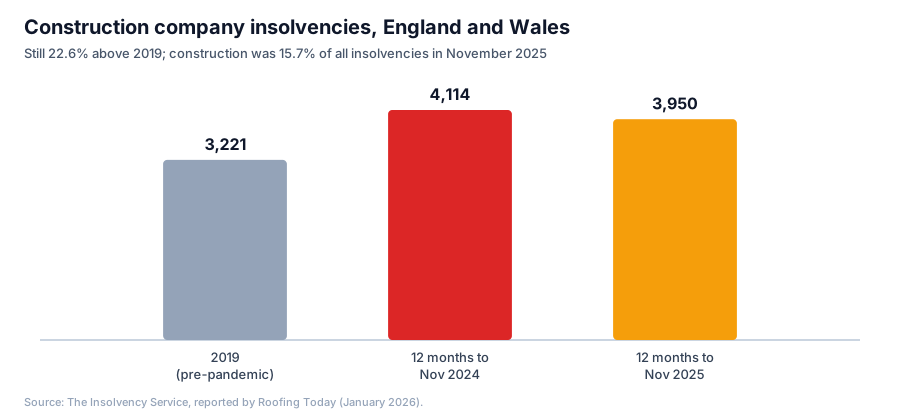
Construction had 3,950 company insolvencies in England and Wales in the 12 months to November 2025: 4.0% fewer than a year earlier, but still 22.6% more than in 2019, according to the Insolvency Service. In November 2025 construction accounted for 15.7% of all insolvencies, against roughly 14% of registered businesses, and specialist trades were the largest group.
Cash is what fails first, and CIS and the reverse charge move a lot of it. On a £12,000 subcontractor invoice — £10,000 labour, £2,000 materials — the contractor deducts 20% CIS on the labour only (£2,000) and pays £10,000. Under the reverse charge the subcontractor charges no VAT; the contractor accounts for the £2,400 itself, as output and input tax. Get either wrong and it's a correction with HMRC and an awkward call with the subcontractor.
The three places contractors lose money
1. Cost overruns found at final account. When purchase orders, subcontract valuations and labour hit the job the day they happen, an overrun shows in week three, not month twelve.
2. Retentions nobody chases. Retentions on dozens of jobs, each with two release dates, add up. With a balance per job and a reminder at each date, they get invoiced on time.
3. CIS and VAT errors. A wrong deduction rate, a missed verification or an invoice with VAT that should have been reverse-charged leads to corrections, penalties and awkward conversations with clients. Built into the system, the rule is applied every time.
Compliance with dates
- CIS monthly returns by the 19th of each month, with deductions at 20% for registered subcontractors, 30% for unverified ones, and gross payment where HMRC has approved it.
- Domestic reverse charge VAT, in force since 1 March 2021, on construction services between VAT-registered businesses in CIS, unless the customer is an end user.
- E-invoicing from April 2029 for all VAT invoices between businesses. What to prepare.
Where contractors come from
From Sage 50 or Sage 200 with valuations in Excel, from construction packages whose finance side can't cope with a second company or a growing supply chain, and from Xero or QuickBooks when the number of jobs and subcontractors outgrows them. Small subcontractors with a handful of jobs are often fine where they are: Xero and QuickBooks both handle CIS and the reverse charge. The move pays when job costing, committed cost and several entities matter. For a small UK company projects typically run £15,000-40,000; with several entities and integrations, £30,000-90,000. For the US equivalent, with retainage instead of retentions, see Business Central for US contractors.
Native versus app
| Requirement | Business Central |
|---|---|
| Projects, budgets, actuals and WIP | Native |
| Committed cost by job | Native |
| Reverse charge VAT | Native |
| Making Tax Digital | Native (UK localisation) |
| Multi-company and consolidation | Native |
| CIS deductions, returns and statements | HMRC-recognised app |
| Applications for payment and valuations | App or focused extension |
| Retentions | App or focused extension |
| Peppol e-invoicing | Native framework, with an access point connector |
How we help
We start with one live job: its budget, its orders, its subcontractors and CIS, its last application for payment and its retentions. That shows what is native, which CIS app fits and what the valuation and retention flow should look like. We write AL, so where your contracts genuinely differ we extend Business Central rather than forcing a workaround. We work remotely in English with contractors anywhere in the UK. Each part is invoiced only after you accept it.
FAQ
Does Business Central do CIS out of the box? No. The UK localisation handles VAT, including the reverse charge, and Making Tax Digital; CIS deductions, verification and monthly returns come from HMRC-recognised apps on AppSource.
Can it handle the reverse charge automatically? Yes: customers and suppliers get the right VAT setup, and invoices carry the reverse charge treatment and wording without anyone remembering to add it.
Do we need Premium? Usually not. Projects, job costing and WIP are in Essentials; Premium adds manufacturing and service management.
How long does it take? Three to six months for most contractors, depending on the number of entities and the CIS and valuation setup.
Free assessment · Evaluación gratuita
Tell us your current system and how many users you have. First reply within one working day. / Cuéntanos tu sistema actual y cuántos usuarios sois. Respondemos en un día laborable.
CIS in a spreadsheet and retentions in a notebook? Free assessment, no commitment.
Bramvia in: Spain · United States · Mexico · United Kingdom · Ireland · Canada · Colombia · Argentina · Chile · Peru · Australia · New Zealand · South Africa · Philippines · Poland · MCP server · Safety stock calculator