
Bramvia — Business Central Experts
From April 2029 every UK VAT invoice between businesses must be a structured e-invoice, and in June 2026 the government confirmed Peppol as the exchange network. What is confirmed, what the November 2026 roadmap still has to settle, what Business Central already does, and a year-by-year plan to be ready without a rush.
Short answer: from April 2029, VAT invoices between UK businesses, and to the public sector, must be structured electronic invoices, not PDFs or paper. The mandate was announced at the Autumn Budget on 26 November 2025, and on 23 June 2026 the government confirmed Peppol as the network: a decentralised "four-corner" model in which your system sends the invoice to your access point, which delivers it to your customer's. There is no real-time reporting to HMRC in the first phase, and a phased start beginning with larger businesses is expected but not yet confirmed. The detailed roadmap and technical standards are due at Budget 2026 in November. For Business Central users the good news is that the machinery already exists: the E-Documents framework produces Peppol invoices, sends them through an access point and turns incoming ones into purchase invoices. The work between now and 2029 is choosing an access point, cleaning master data, testing with your largest customers and suppliers, and deciding whether your current system can do this at all.
Sound familiar?
- Your invoices leave as PDFs attached to emails, and someone in your customers' accounts team retypes them.
- Your purchase ledger team keys supplier invoices by hand, and the month-end close waits for them.
- You supply the NHS or a large retailer and already had to "do something with Peppol" for one customer.
- You run Sage 50, Sage 200, Xero or QuickBooks and have no idea whether it will produce a compliant e-invoice in 2029.
- You have a Spanish, Belgian or Polish subsidiary that is already dealing with its own e-invoicing rules.
If two or more ring true, this guide is for you. At the end we explain how we help.
The timeline
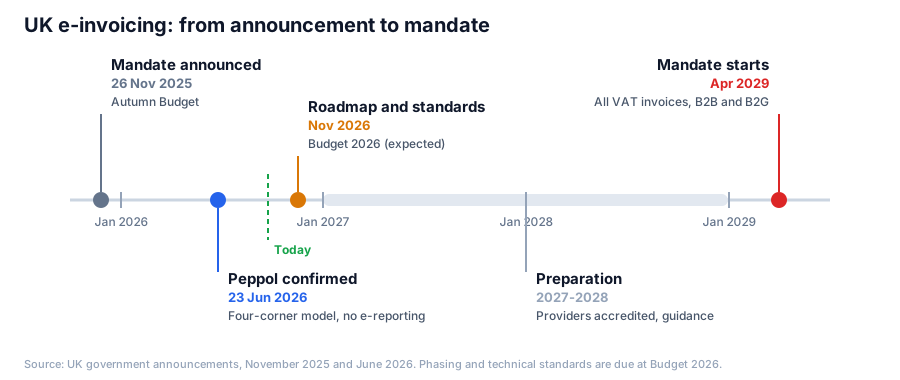
| Date | What happens | Status |
|---|---|---|
| 26 November 2025 | Autumn Budget announces mandatory e-invoicing for all VAT invoices from April 2029, B2B and B2G | Confirmed |
| 23 June 2026 | Government confirms Peppol as the interoperability framework, four-corner model | Confirmed |
| November 2026 | Budget 2026: implementation roadmap and technical standards | Expected |
| 2027-2028 | Preparation; accreditation of providers and detailed guidance | Expected |
| April 2029 | Mandate starts; a phased start with larger businesses first is likely | Date confirmed, phasing not |
| Later | Possible e-reporting of invoice data to HMRC in a second phase | Not decided |
What is confirmed, and what is not
| Confirmed | Still open until the roadmap |
|---|---|
| April 2029 start for VAT invoices, business to business and to government | Whether all businesses start in April 2029 or larger ones first |
| Peppol as the exchange network | The exact UK format profile and validation rules |
| Four-corner model through accredited providers | How access points will be accredited |
| No real-time e-reporting to HMRC at the start | Whether and when e-reporting follows |
| No small-business exemption announced | Transitional rules and penalties |
Two things do not change. Making Tax Digital for VAT stays: the VAT return is still submitted through MTD-compatible software (how that works in Business Central). And you still have to keep VAT records for six years; the e-invoice becomes one of them.
What Business Central already does
Business Central's E-Documents framework is the engine for this, and it is the same one used today for Peppol in other countries. The full setup guide covers it step by step; in short:
- Outgoing. When you post a sales invoice or credit memo, the framework builds a Peppol invoice, validates it against the format rules (a missing VAT number or a wrong unit code is caught before it leaves) and sends it through your access point.
- Incoming. Supplier invoices arrive through the access point, are imported automatically and matched to your purchase orders and receipts. Within tolerance, they become draft purchase invoices; nobody retypes them. The Payables Agent, which reads invoices straight from the E-Documents inbox, can take much of the review off your team.
- Access point. You pick a provider with a Business Central connector on AppSource. Which ones will be accredited for the UK is exactly what the roadmap should settle, so it is worth waiting for November before signing a multi-year contract.
What Business Central cannot do for you is the master data. Every customer needs a correct VAT number and a Peppol participant ID; units of measure must map to standard codes; credit notes must reference the invoice they correct; and large buyers will insist on their purchase order number on every invoice. That clean-up is where most of the preparation time goes, whatever the system.
If you are not on Business Central
The mandate applies to the invoice, not to the software, so every accounting package will have to support it, and the big ones will. The question is what else your system does. If invoices are already the least of your problems, because stock lives in spreadsheets, several entities are consolidated by hand or the close takes weeks, 2029 is a natural date to fix both at once rather than paying twice. Our guides to moving from Sage 50 and from Sage 200 cover what moves, what it costs and when staying put is the better answer.
UK groups with subsidiaries in Europe
A UK group with a subsidiary in the EU is dealing with several regimes at once, each on its own date: Belgium already requires Peppol e-invoices between businesses, Spain's mandate starts on 6 October 2027 for companies above €8 million turnover and on 6 October 2028 for the rest, and Poland's KSeF is running for most companies since 2026. In Business Central the framework is the same for all of them; the formats, access points and reporting differ by country. Running them in one tenant, with one partner who knows each, is far cheaper than a separate project per country. How we support Spanish subsidiaries of international groups.
A year-by-year plan
Now to the November 2026 Budget. Inventory how you invoice: how many customers, how many invoices a month, which customers already ask for Peppol or EDI. Count the supplier invoices you key by hand; that number is your business case for automating the incoming side.
After the roadmap (late 2026 to 2027). Choose an access point that is on track for UK accreditation and has a Business Central connector. Start the master data clean-up: VAT numbers, Peppol IDs, units of measure, purchase order references.
2027 to 2028. Switch on incoming e-invoices first; it removes keying immediately and carries no compliance risk. Then send e-invoices to the customers who accept them voluntarily, starting with the largest. Fix what their systems reject.
Before April 2029. Every customer on e-invoicing, PDFs retired, and the purchase ledger running on imported invoices. If the larger-businesses-first phasing is confirmed and you are in the first wave, move this whole plan a year earlier.
How we help you solve it
We configure the E-Documents framework and the access point connector in Business Central, clean the master data with you, and test the flow with your largest customers and suppliers before anything goes live. For groups with a Spanish or Polish subsidiary, we run those local regimes (SII, Verifactu, Spanish e-invoicing, KSeF) in the same tenant. If you are not on Business Central yet, we start with an honest assessment of whether your current system can meet the mandate on its own. As with everything we do, each part is invoiced only after you accept it.
FAQ
Is e-invoicing mandatory in the UK now? Not for business-to-business invoices. It becomes mandatory from April 2029. NHS suppliers already invoice through Peppol, and public bodies must be able to receive structured e-invoices.
Will HMRC see every invoice? Not in the first phase: the confirmed model is an exchange between businesses through their providers, without real-time reporting to HMRC. A later reporting phase has not been ruled out.
Does a PDF invoice by email count as an e-invoice? No. An e-invoice is structured data that the receiving system can read without retyping. A PDF is a picture of an invoice.
Do I need to replace my accounting system? Not because of the mandate alone: every mainstream package will have to support it. You may want to if the mandate is the last straw on top of stock, multi-entity or reporting problems.
Should I choose an access point now? Wait for the November 2026 roadmap before signing a long contract, since it should set out how providers are accredited. You can start the master data clean-up and the incoming-invoice automation today.
By sector: food and drink manufacturers, wholesale distributors and construction contractors.
Free assessment · Evaluación gratuita
Tell us your current system and how many users you have. First reply within one working day. / Cuéntanos tu sistema actual y cuántos usuarios sois. Respondemos en un día laborable.
Want to know how much of the work your Business Central, or your current system, already does? Request a free assessment: we look at how you invoice today and give you a plan for 2029, before the roadmap lands.
Bramvia in: Spain · United States · Mexico · United Kingdom · Ireland · Canada · Colombia · Argentina · Chile · Peru · Australia · New Zealand · South Africa · Philippines · Poland · MCP server · Safety stock calculator