
Bramvia — Business Central Experts
What a US job shop or make-to-order manufacturer needs from its ERP — fast quotes that match the actual, production orders from sales orders, routings and capacity, subcontracting, quality and real job costing — and what Business Central Premium does natively versus what needs an app, with steel and aluminum tariffs moving material costs.
Short answer: a job shop or make-to-order manufacturer — machining, fabrication, sheet metal, plastics, assemblies built to a customer's drawing — needs six things from its ERP: quotes built from material, routing and outside processing that you can trust; production orders created straight from the sales order; routings and work centers with enough capacity visibility to promise a date; subcontracting for heat treat, plating and coating; quality checks with lot or serial traceability; and job costing that compares the quote with the actual on every job. Business Central Premium does production orders from sales orders, routings, work centers, capacity, subcontracting, quality inspections and expected-versus-actual costing natively. Quoting and estimating for engineered parts, finite scheduling and shop-floor data collection come from AppSource apps. The pressure in 2026 is cost: with Section 232 tariffs on steel and aluminum and duties on imported components, a quote built on last quarter's material price can lose the job's margin before the first cut.
Sound familiar?
- Quotes take days because the estimator rebuilds each one in a spreadsheet.
- Jobs finish over the quoted cost and nobody can say whether it was material, setup or scrap.
- Promise dates are guesses; the shop floor finds out about hot jobs from the owner.
- Outside processing goes out on a paper traveler and comes back when it comes back.
- The accounting system knows revenue and payroll; everything else lives in the job-shop package or on the floor.
The day-to-day of a make-to-order shop
It's the same across the machining and fabrication belts of Ohio, Michigan, Wisconsin, Indiana and Pennsylvania, and in Texas around Houston and Dallas:
- RFQs every day, many for parts you have never made, some for repeat parts with a new revision.
- Material bought per job, often steel, aluminum or resin whose price changed since the last order.
- Routings through saws, CNC, press brakes, welding, finishing, and outside operations at vendors.
- Hot jobs that jump the queue and push everything else back.
- Certifications and inspections customers audit: first article, material certs, lot or serial traceability.
- Margin decided at the quote and lost, or kept, on the floor.
What the ERP must do, and how Business Central does it
| Requirement | How it's handled |
|---|---|
| Quotes for engineered parts | Quoting/estimating app, or sales quotes with a costed BOM and routing for repeat parts |
| Production order from the sales order | Native: order planning creates the production order linked to the sales order |
| Routings, work centers, machine centers | Native (Premium), with setup, run and wait times |
| Capacity and load | Native capacity and load views; finite scheduling through an app |
| Outside processing | Native subcontracting: routing operation at a vendor, purchase order generated (setup guide) |
| Material cost per job | Purchases linked to the production order; landed cost with duties and freight |
| Quality checks and holds | Quality Management extension: inspections, holds and release |
| Lot and serial traceability | Native item tracking through production |
| Job costing: quote vs actual | Native expected versus actual cost per production order (quote-to-actual) |
| Shop-floor time and quantities | Shop-floor data collection app, or output journal entries |
An example with numbers
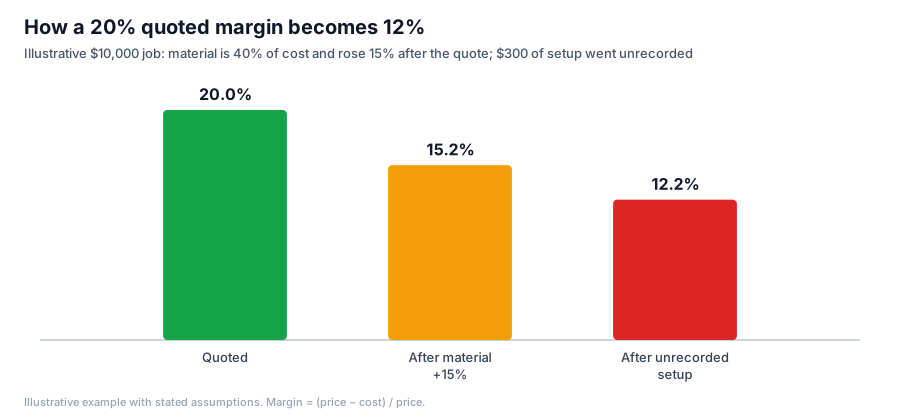
Take a $10,000 job quoted at a 20% margin: $8,000 of cost, 40% of it material. If the material price rises 15% between the quote and the purchase, cost goes to $8,480 and the margin to 15.2%. Add $300 of setup nobody recorded and it's 12.2%. Two-fifths of the margin gone without anyone deciding to give it away. It's an illustration, but both leaks are measurable on every job when material is bought against the production order and setup is booked as it happens.
The three places job shops lose money
1. Stale material in the quote. A quote that uses the last purchase price for steel or aluminum, when tariffs have moved it since, gives the margin away before production starts. Quoting from current purchase prices, and requoting when they move, protects it.
2. Setup and scrap nobody records. If setup time and scrap aren't captured on the production order, every job looks like it ran at standard, and the next quote repeats the mistake. Job costing explained.
3. Promise dates without capacity. Saying yes to a date the shop can't hit costs expedited freight, overtime and customers. Load by work center before the promise turns guesses into commitments.
Where job shops come from
From QuickBooks plus a job-shop package such as JobBOSS² or E2 when the business adds a second site, a second entity or customers who want EDI and certifications; from Epicor when the upgrade bill arrives; and from old NAV. Manufacturing needs Business Central Premium at $110 per full user per month (Essentials vs Premium); shared shop-floor terminals can often use device licenses instead of full users. Typical projects run $45,000-100,000 for a mid-sized shop with routings, subcontracting and one or two integrations (cost breakdown).
Native versus app
| Requirement | Business Central |
|---|---|
| Production orders from sales orders | Native (Premium) |
| BOMs, routings, work centers, capacity | Native (Premium) |
| Subcontracting | Native |
| Quality inspections and holds | Native (Quality Management) |
| Expected vs actual cost per job | Native |
| Lot and serial tracking | Native |
| Quoting and estimating for engineered parts | App |
| Finite scheduling | App |
| Shop-floor data collection | App |
How we help
We start with three real jobs: one quoted and won, one that ran over, one repeat part. We trace each from RFQ to invoice, then decide what is native, which apps fit your shop and what the floor will actually use. We write AL, so where your process genuinely differs we extend Business Central instead of forcing a workaround. We work with companies anywhere in the US, with team members in several states. Each part is invoiced only after you accept it.
FAQ
Is Business Central strong enough for a job shop? For most small and mid-sized shops, yes, with Premium plus the right apps for quoting, scheduling and shop-floor data. Very high-mix shops with complex engineering change control sometimes need a dedicated manufacturing ERP; we'll tell you if you're one of them.
Can it create a production order from each sales line? Yes: order planning creates production orders linked to the sales order, and the job's cost is tracked against it.
How do tariffs show up in job cost? Through the purchase price of material bought for the job, plus item charges for duties and freight on imported components. The expected-versus-actual view shows how much of an overrun came from material.
Do we need to replace our CAD or MES? No. CAD stays; BOMs can be imported from it. An existing MES or data-collection system can feed output and time into production orders.
Free assessment · Evaluación gratuita
Tell us your current system and how many users you have. First reply within one working day. / Cuéntanos tu sistema actual y cuántos usuarios sois. Respondemos en un día laborable.
Jobs finishing over the quote and no one sure why? Free assessment, no commitment.
Bramvia in: Spain · United States · Mexico · United Kingdom · Ireland · Canada · Colombia · Argentina · Chile · Peru · Australia · New Zealand · South Africa · Philippines · Poland · MCP server · Safety stock calculator