
Bramvia — Business Central Experts
Fresh produce and seafood distributors handle foods on the FDA's Food Traceability List, and retailers are already writing FSMA 204 into supplier contracts ahead of the July 20, 2028 compliance date. What the rule asks of your system, what Business Central records natively, and what needs an app or a focused extension.
Short answer: fresh produce and seafood distributors sit in the middle of FSMA 204. Most of what they move — fresh tomatoes, peppers, cucumbers, leafy greens, herbs, melons, tropical tree fruits, fresh-cut produce, finfish, crustaceans and molluscan shellfish — is on the FDA's Food Traceability List, so from July 20, 2028 they must keep key data elements at each critical tracking event (receiving, shipping, transformation), link them to a traceability lot code, and hand the FDA a sortable spreadsheet within 24 hours when asked. Retailers such as Walmart, Kroger and Albertsons are already putting traceability clauses into supplier contracts, so the practical deadline is your next contract renewal. Business Central records lots, expiry, FEFO picking and forward and backward tracing natively; the FSMA-specific data fields and the 24-hour report are a focused extension, catch weight comes from an app, and retailer EDI from an EDI provider.
Sound familiar?
- A lot code is written on the case but typed into the system only sometimes.
- A recall drill means pulling paper bills of lading and matching them to invoices by hand.
- You sell by the case but invoice by the pound, and the actual weight is captured in a separate scale system.
- Product ages in the cooler because picking follows the order the pallets arrived in, not their dates.
- A retailer sent a new supplier agreement with a traceability addendum and nobody knows if you can comply.
The day-to-day of a produce or seafood distributor
Whether you import through Nogales or McAllen–Pharr, ship from the Salinas Valley, sell around the terminal markets in the Bronx, Philadelphia or Los Angeles, or handle seafood in Boston, New Bedford, Seattle or Miami:
- Short shelf life: days, not months. Picking by first-expired-first-out is the difference between margin and shrink.
- Receipts from growers, packers and importers, many with their own lot codes that have to be kept, not replaced.
- Repacking and transformation: cutting, repacking, relabeling. Under FSMA 204 that creates a new traceability lot code.
- Catch weight for fish and much produce: sold by the case, priced by the pound.
- Customers from retail chains to restaurants, with EDI on one side and phone orders on the other.
- Produce-specific rules: PACA trust language on invoices; country-of-origin labeling for fish and shellfish.
What FSMA 204 asks of your system
| Requirement | In practice |
|---|---|
| Traceability lot code (TLC) | Keep the supplier's code on receipt; assign a new one when you transform |
| Key data elements at each critical tracking event | Who, what, where, when and how much at receiving, shipping and transformation |
| Traceability lot code source | Where the TLC was assigned (the packer, the processor, you) |
| Records within 24 hours | An electronic, sortable spreadsheet when the FDA asks during an outbreak |
| Traceability plan | Your written procedures for maintaining the records |
How Business Central does it
| Requirement | How it's handled |
|---|---|
| Lot numbers and expiry dates | Native item tracking on receipt, transfer and shipment |
| FEFO picking | Native pick-by-expiration on warehouse locations |
| Forward and backward tracing | Native item tracing: from a lot to every customer, and back to every receipt |
| Supplier lot code kept as the TLC | Lot number or lot attribute on receipt |
| KDEs, TLC source and event data | Focused extension: fields per event and the 24-hour sortable report |
| Repack and transformation | Assembly or production orders consuming lots and creating new ones |
| Catch weight | App: dual unit of measure through order, pick, ship and invoice |
| Retailer EDI | EDI provider app connected to sales orders, shipments and invoices |
| PACA trust language | Invoice layout text |
| Quality holds | Quality Management extension: lots on hold until released |
The numbers
The US depends on imports for much of its fresh produce. According to México, ¿cómo vamos?, 35% of the fresh vegetables available in the US are imported, with Mexico supplying 69% of them; for tomatoes the share is 70%, with Mexico at 90% of imports; for raspberries it was 82.3% in 2024; and for avocados, 88.4%.
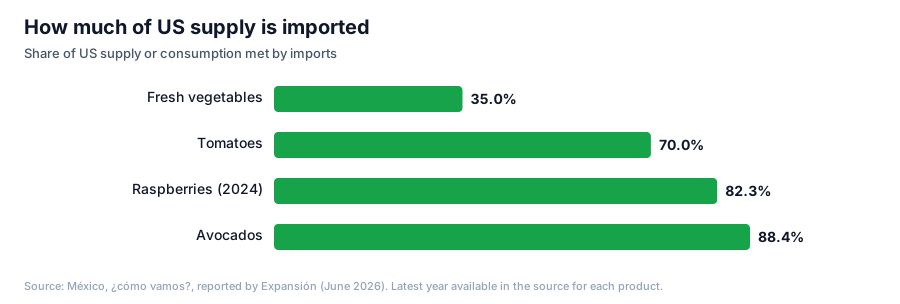
Much of that product reaches your warehouse with a grower's or packer's lot code already on the case. Under FSMA 204 that code is the traceability lot code you have to keep and pass on, not replace. A system that overwrites it at receiving breaks the chain on day one.
The three places distributors lose money
1. Shrink from picking the wrong lot. FEFO on every pick, plus alerts on lots close to expiry, turns write-offs into sales.
2. Weight given away. Cases invoiced at nominal weight when the real weight was higher. With catch weight captured at pick and invoiced, the difference comes back.
3. Losing a customer at renewal. A retailer that can't get FSMA 204 data from you will buy from someone who can. The cost isn't the fine; it's the account.
Where these distributors come from
From QuickBooks plus a produce or seafood package that holds the lots but not the finance, from old NAV or Dynamics GP, and from spreadsheets that carry the lot codes nobody else keeps. Distribution runs on Business Central Essentials at $80 per full user per month; typical projects run $25,000-45,000 for a small distributor and $45,000-100,000 with several locations, EDI and catch weight (cost breakdown). For food manufacturers rather than distributors, see Business Central for food and beverage manufacturing.
Native versus app
| Requirement | Business Central |
|---|---|
| Lots, expiry and FEFO picking | Native |
| Forward and backward tracing | Native |
| Repack and transformation with new lots | Native |
| Quality holds | Native (Quality Management) |
| Landed cost for imports | Native |
| FSMA 204 KDE fields and 24-hour report | Focused extension |
| Catch weight | App |
| Retailer EDI | App |
How we help
We start with one lot: follow it from the grower's or importer's receipt, through any repack, to every customer it reached. Where the data breaks is where the project starts. We configure lots and FEFO, build the FSMA 204 fields and the 24-hour report, and connect the catch-weight and EDI apps you choose. We work with companies anywhere in the US, with team members in several states. Each part is invoiced only after you accept it.
FAQ
When does FSMA 204 apply? The compliance date is July 20, 2028, after Congress directed the FDA not to enforce the rule before then. The rule itself did not change, and retailers are already asking for the data.
Does it apply if we only distribute and don't process? Yes, for foods on the Food Traceability List: the rule covers businesses that manufacture, process, pack or hold those foods, which includes distributors and warehouses.
Can Business Central produce the FDA spreadsheet? Yes, with a focused extension that stores the key data elements per event and exports them sorted by lot, date and product.
We import from Mexico and Latin America. Does that change anything? Your foreign suppliers are covered too, and you'll depend on their lot codes and data. Keeping their code as the traceability lot code on receipt is the simplest path.
Free assessment · Evaluación gratuita
Tell us your current system and how many users you have. First reply within one working day. / Cuéntanos tu sistema actual y cuántos usuarios sois. Respondemos en un día laborable.
Could you trace a lot to every customer in 24 hours today? Free assessment, no commitment.
Bramvia in: Spain · United States · Mexico · United Kingdom · Ireland · Canada · Colombia · Argentina · Chile · Peru · Australia · New Zealand · South Africa · Philippines · Poland · MCP server · Safety stock calculator