
Bramvia — Business Central Experts
What a US wholesale distributor needs from its ERP in 2026 — landed cost that reflects tariffs by origin, EDI and chargebacks with big-box retailers, a warehouse that tells the truth, sales tax across states — and what Business Central does out of the box versus what needs an app.
Short answer: a US wholesale distributor needs five things from its ERP that entry-level systems don't do well: landed cost that carries freight, duties and tariffs by country of origin into every item cost; EDI with big-box and national accounts, including the chargebacks and deductions that come with them; a warehouse with bins, directed picking and scanning so the stock figure is true; customer-specific pricing and credit control; and sales tax across every state where you have nexus. Business Central does landed cost (item charges), country of origin, multi-location warehousing with directed put-away and pick, pricing, credit control and approvals natively; EDI, chargeback management, rebates and handheld scanning come from established AppSource apps, and sales tax from an Avalara or Vertex integration. The trigger in 2026 is margin: with tariffs changing by origin, a distributor whose system holds a stale standard cost is quoting from last year's numbers.
Sound familiar?
- Item costs haven't been updated since the last tariff change, and quotes go out on those costs.
- Retailer chargebacks and short-pays land in accounts receivable and nobody disputes them.
- The system says 40 on hand, the bin has 12, and the customer order already shipped short.
- Sales reps build special pricing in spreadsheets and the invoice doesn't match what they promised.
- You added two states this year and nobody is sure the sales tax setup followed.
The day-to-day of a distributor
The profile repeats in every distribution hub — Chicago, Dallas–Fort Worth, Atlanta, Los Angeles and the Inland Empire, northern New Jersey, Houston, Memphis:
- Thousands of SKUs across one or several warehouses, many imported, some with lot or expiry control.
- Orders from everywhere: EDI from national accounts, email and phone from independents, a B2B web store, reps in the field.
- Customer-specific pricing: contract prices, volume breaks, promotions, vendor-funded programs.
- Retail compliance: ship windows, labels, ASNs, and chargebacks when any of them is off.
- Tight margins that move with freight, tariffs and supplier price increases.
- Credit risk concentrated in a few large customers.
What the ERP must do, and how Business Central does it
| Requirement | How it's handled |
|---|---|
| Landed cost with freight, duties and tariffs | Item charges assigned to receipts; actual cost flows to inventory and margin (landed cost explained) |
| Country of origin per item | Standard item field, available for tariff analysis and duty reporting |
| Multi-location, bins, directed put-away and pick | Standard warehouse management (90-day rollout plan) |
| Handheld scanning | AppSource apps built on Business Central warehouse |
| EDI (850, 856, 810) with retailers | EDI apps from established providers |
| Chargebacks and deductions | App or focused extension: deduction reason, dispute, recovery |
| Customer pricing and discounts | Standard price lists by customer, group and campaign, with dates |
| Credit limits and holds | Standard credit limit checks and approvals (credit control) |
| Sales tax across states | Avalara or Vertex integration |
| Orders by email | Sales Order Agent: reads the order and drafts it for confirmation |
| Vendor invoices | Payables Agent and AP automation |
| B2B web store | Shopify B2B connector |
The numbers
Distributors are the second-largest group of companies shopping for an ERP: 18% of buyers, after manufacturers at 47%, according to NetSuite's ERP statistics. Most of them arrive for the same reason, a margin they can no longer see.
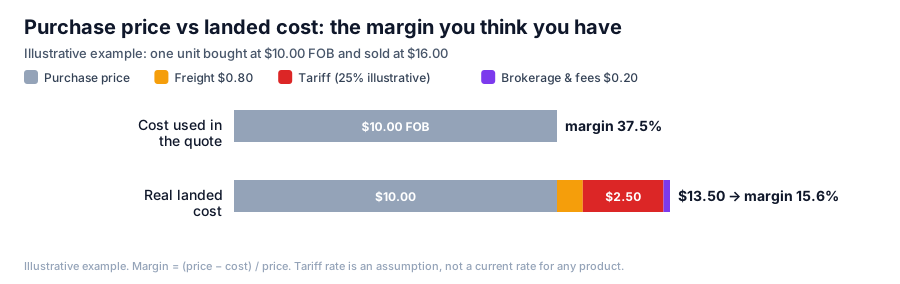
Take one unit bought at $10.00 FOB and sold at $16.00. On purchase price the margin looks like 37.5%. Add $0.80 of freight, a tariff (25% in this illustration, not a current rate for any product) and $0.20 of brokerage and fees, and the landed cost is $13.50: the real margin is 15.6%. A distributor quoting from purchase price is giving away more than half of the margin on that line without knowing it.
The three places distributors lose money
1. Stale landed cost. If tariffs and freight don't reach the item cost at receipt, margin reports lie and quotes go out too low. With item charges on every receipt, the next quote uses the real number.
2. Chargebacks nobody disputes. A share of retailer deductions is invalid, but disputing them takes evidence (the ASN, the proof of delivery, the routing guide). With deductions tracked by reason, the recoverable ones get recovered.
3. Dead stock bought on a forecast. Safety stock added in 2024 and 2025 was rational; knowing which SKUs are now dead is what frees the cash. How to find them.
Where distributors come from
From QuickBooks with a warehouse app bolted on, from Sage 100 or Dynamics GP, from old NAV with years of customizations, and sometimes from NetSuite when the renewal arrives. Typical projects run $25,000-45,000 for a small distributor with standard processes and $45,000-100,000 with several warehouses, EDI and integrations (cost breakdown); licenses are $80 per full user per month on Essentials, which covers distribution (Essentials vs Premium).
Native versus app
| Requirement | Business Central |
|---|---|
| Landed cost and country of origin | Native |
| Multi-location warehouse, bins, directed pick | Native |
| Pricing, discounts, credit control | Native |
| Lot and expiry tracking | Native |
| Multi-company and consolidation | Native |
| EDI with retailers | App |
| Handheld scanning | App |
| Chargebacks, deductions and rebates | App or focused extension |
| Sales tax | Avalara or Vertex integration |
How we help
We start with your real flows: how an import is received and costed, how an EDI order becomes a shipment, how a deduction is handled. Then we separate native from app, pick the apps with you and connect sales tax. We've supported a US distribution client for two years, we work with US partners who can supply licenses (including Bridge to Cloud for NAV and GP customers), and our team covers US hours. Each part is invoiced only after you accept it.
FAQ
How do distributors manage retailer chargebacks and deductions in Business Central? With an app or a focused extension on top of standard receivables: each deduction is logged with its reason, matched to the order, shipment and ASN, and routed for dispute or write-off, so the recoverable ones get recovered.
Does Business Central handle tariffs? It carries tariffs and duties into item cost through item charges on each receipt, and keeps country of origin on the item. Tariff classification and duty rates come from your broker; the ERP makes sure the cost reaches the margin.
Do we need Premium? No, unless you manufacture or assemble with production orders. Essentials covers distribution and warehousing.
Can it handle Walmart, Target or Home Depot EDI? Yes, through EDI apps from established providers that connect to Business Central sales orders, shipments and invoices.
How long does it take? Three to six months for most distributors; longer with several warehouses and many trading partners.
See it running: territory maps, on-time shipping statistics and every order's timeline from PO to shipment, inside Business Central. Try the Sales & Shipping Analytics demo.
Related: ERP with POS for trade counters and stores.
Free assessment · Evaluación gratuita
Tell us your current system and how many users you have. First reply within one working day. / Cuéntanos tu sistema actual y cuántos usuarios sois. Respondemos en un día laborable.
Quoting from last year's costs or losing chargebacks nobody disputes? Free assessment, no commitment.
Bramvia in: Spain · United States · Mexico · United Kingdom · Ireland · Canada · Colombia · Argentina · Chile · Peru · Australia · New Zealand · South Africa · Philippines · Poland · MCP server · Safety stock calculator