
Bramvia — Business Central Experts
What a UK food or drink manufacturer needs from its ERP — lot traceability for BRCGS audits, recipes and yield, shelf life and FEFO, retailer EDI, packaging data for EPR reporting and fees — and what Business Central does out of the box versus what needs an app, with e-invoicing becoming mandatory in April 2029.
Short answer: a UK food or drink manufacturer needs its ERP to do six things well: lot traceability from ingredient to customer for BRCGS audits and mock recalls; recipes with versions, yield and costing; shelf life with first-expired-first-out picking; retailer EDI, promotions and deductions; packaging data by material and weight for Extended Producer Responsibility; and structured e-invoices from April 2029. Business Central Premium does lot and expiry tracking, forward and backward tracing, production BOMs and routings with versions, FEFO, quality inspections and holds natively. Retailer EDI comes from an established EDI provider, catch weight from an app, and the packaging composition per item from a focused extension. The pressure in 2026 is packaging: large producers now report packaging data every six months, and fees are modulated by recyclability from the 2026-27 scheme year, so the cost of each pack depends on data most ERPs don't hold.
Sound familiar?
- A mock recall takes an afternoon of cross-referencing batch sheets with dispatch notes.
- Recipe costs were set at launch and nobody has recalculated them since ingredient prices moved.
- The packaging EPR submission is built from a spreadsheet that only one person understands.
- Retailer promotions and deductions are reconciled weeks after the event, if at all.
- Short-dated stock gets written off because picking follows the order pallets arrived in.
The day-to-day of a food and drink manufacturer
From Lincolnshire — Grimsby for seafood, Spalding for fresh produce — to Yorkshire, the Midlands, East Anglia, Scotland and Northern Ireland, the pattern is the same:
- Ingredients with batches and allergens, from UK and EU suppliers, with certificates to keep.
- Production to recipes with versions, yields and by-products, on lines that change over several times a day.
- Short shelf life and customers who reject stock below a minimum life on delivery.
- Major retailers with EDI orders, promotions, service-level penalties and deductions; wholesalers and food service on the side.
- Audits: BRCGS or SALSA, customer technical audits, mock recalls on demand.
- Packaging on every product, now with a cost attached.
What the ERP must do, and how Business Central does it
| Requirement | How it's handled |
|---|---|
| Ingredient and finished-goods lot tracking | Native item tracking with expiry dates through receipt, production and dispatch |
| Mock recall in minutes | Native item tracing, forward and backward |
| Recipes with versions and yield | Production BOMs and routings with versions (Premium) |
| Recipe costing | Standard and actual cost per production order; roll-up after ingredient price changes |
| Shelf life and FEFO | Native pick-by-expiry; minimum remaining life checked with a focused extension |
| Quality checks and holds | Quality Management extension: inspections, holds and release |
| Retailer EDI | EDI provider app connected to orders, dispatches and invoices |
| Promotions and deductions | App or focused extension |
| Catch weight | App |
| Packaging data for EPR | Focused extension: components, material, weight and recycled content per item, reported by period |
| e-invoicing (April 2029) | E-Documents framework over Peppol (what the mandate requires) |
| VAT returns | Making Tax Digital, native in the UK localisation |
The numbers
Year-one packaging EPR base fees (2025-26) range from £192 per tonne for glass to £423 for plastic and £461 for fibre-based composites, according to PackUK.
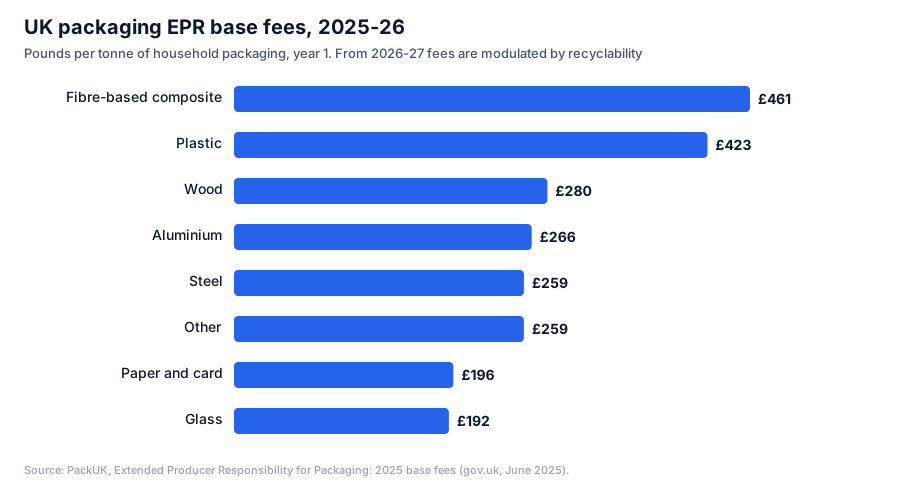
Put a product behind it. A manufacturer shipping 10 million ready-meal packs a year, each with a 30 g plastic tray and a 10 g board sleeve, places 300 tonnes of plastic and 100 tonnes of board on the market: £126,900 plus £19,600, or £146,500 a year at year-one base fees if all of it is household packaging. From 2026-27 the plastic fee depends on recyclability, so the tray design shows up on the invoice. It's an illustration, but the calculation is exactly the one the packaging data per item makes possible.
The three places manufacturers lose money
1. Recipes costed once. When ingredient prices move and recipe costs don't, the margin on each retailer line is fiction. With costs rolled up from current purchase prices, the renegotiation starts from facts.
2. Promotions and deductions nobody reconciles. Retailer deductions and promotional funding settled weeks later, without checking them against what was agreed, leak money every period.
3. Packaging paid for twice. Once when you buy it, again in EPR fees on the tonnage you report. Without packaging weight per item, the report is an estimate and the modulated fee on hard-to-recycle packs is invisible until the invoice arrives.
Compliance with dates
- Packaging EPR: large producers (turnover above £2 million and more than 50 tonnes of packaging a year) report every six months, by 1 April and 1 October. From the 2026-27 scheme year, fees are modulated by recyclability, and nation-of-sale data collected from January 2026 is first due on 1 April 2027.
- E-invoicing from April 2029, with Peppol confirmed as the network. What to do now.
- Making Tax Digital for VAT continues. How it works in Business Central.
Where food manufacturers come from
From Sage 200 or Sage 50 with production and traceability in spreadsheets, from specialist food packages whose finance side never kept up, and from old Dynamics NAV. For a mid-sized UK company, projects typically run £30,000-90,000 depending on processes and integrations; manufacturing needs Business Central Premium.
Native versus app
| Requirement | Business Central |
|---|---|
| Lot and expiry tracking, tracing | Native |
| Recipes, versions, production orders | Native (Premium) |
| FEFO picking | Native |
| Quality inspections and holds | Native (Quality Management) |
| Making Tax Digital | Native (UK localisation) |
| Peppol e-invoicing | Native framework, with an access point connector |
| Retailer EDI | App |
| Catch weight | App |
| Promotions and deductions | App or focused extension |
| Packaging data per item for EPR | Focused extension |
How we help
We start with one product: follow a finished-goods lot back to its ingredient lots, cost its recipe from current prices and build its packaging record. That shows where your data is and where it isn't. Then we separate native from app, build the packaging extension and prepare the e-invoicing flow. We work remotely in English with companies anywhere in the UK, with Spanish and Polish for groups with EU operations. Each part is invoiced only after you accept it.
When a lot fails a lab test, the ERP should block it, show which customers already have it and record the nonconformity. Try it with a batch of olive oil:
FAQ
Is Business Central suitable for BRCGS audits? The standard sets requirements for your food safety system; Business Central provides the traceability, quality records and recall reporting that auditors ask to see.
Does it handle allergens? Allergen data can be held on ingredients and carried to recipes with item attributes or a focused extension; labeling itself usually sits in a dedicated labeling system fed from the ERP.
Do we need a separate EPR tool? Not necessarily. If the packaging composition per item is in Business Central, the six-monthly data is a report on what you sold. Some producers still use a compliance scheme to submit; the data comes from the ERP either way.
How long does it take? Four to eight months for a typical mid-sized manufacturer, planned around peak season.
Related: ERP for UK breweries and distilleries and ERP for UK pest control companies.
Free assessment · Evaluación gratuita
Tell us your current system and how many users you have. First reply within one working day. / Cuéntanos tu sistema actual y cuántos usuarios sois. Respondemos en un día laborable.
Recipe costs out of date, or an EPR submission built in a spreadsheet? Free assessment, no commitment.
Bramvia in: Spain · United States · Mexico · United Kingdom · Ireland · Canada · Colombia · Argentina · Chile · Peru · Australia · New Zealand · South Africa · Philippines · Poland · MCP server · Safety stock calculator