
Bramvia — Business Central Experts
What a UK wholesaler or importer needs from its ERP — landed cost after duties and freight, postponed import VAT, a warehouse that tells the truth, customer pricing and credit control, packaging data for EPR as an importer, and structured e-invoices from April 2029 — and what Business Central does natively.
Short answer: a UK wholesale distributor or importer needs its ERP to handle landed cost after duties, freight and fees; postponed import VAT reconciled against HMRC's monthly statement; a warehouse with locations, scanning and cycle counts; customer-specific pricing and credit control; packaging data, because an importer of packaged goods is a producer under Extended Producer Responsibility; and, from April 2029, structured e-invoices over Peppol. Business Central does landed cost with item charges, multi-location warehousing with directed put-away and pick, price lists, credit limits, Making Tax Digital and the E-Documents framework natively. Handheld scanning, EDI and rebate management come from established apps, and packaging composition per item from a focused extension. The reason many UK wholesalers are reviewing their system now is the combination: Sage or a stock app bolted onto Xero was fine until warehouses, EPR reporting and the e-invoicing mandate arrived in the same few years.
Sound familiar?
- Import costs sit in a spreadsheet and never reach the item cost, so margins by product are guesses.
- The postponed VAT statement from HMRC is reconciled by hand every month, if at all.
- Stock figures in the system and on the shelf disagree, and the difference is written off at year end.
- Customer-specific prices live in the sales team's heads and spreadsheets.
- As an importer, you're now told you have packaging EPR obligations and don't know your tonnage.
The day-to-day of a UK wholesaler
Whether you run from the Midlands' golden triangle around Northampton, Leicester and Coventry, from Greater Manchester, from West Yorkshire around Leeds and Wakefield, or from London and the South East:
- Imports from the EU and further afield, each with duty, freight, clearance fees and import VAT.
- Thousands of SKUs in one or more warehouses, with trade counters, deliveries and carriers.
- Customers from national accounts to independents, with contract prices, rebates and credit terms.
- Orders by EDI, email, phone and a B2B web store.
- Month-end that waits for stock valuation, import cost allocation and the VAT reconciliation.
What the ERP must do, and how Business Central does it
| Requirement | How it's handled |
|---|---|
| Landed cost (duty, freight, fees) | Item charges assigned to receipts; actual cost reaches inventory and margin (landed cost explained) |
| Postponed import VAT | VAT setup for postponed accounting, reconciled against HMRC's monthly postponed import VAT statement |
| Multi-location, bins, directed put-away and pick | Native warehouse management (rollout plan) |
| Handheld scanning | App built on Business Central warehouse |
| Customer pricing and discounts | Native price lists by customer, group and campaign |
| Credit limits and holds | Native credit checks and approvals (credit control) |
| Rebates | App or focused extension |
| EDI with national accounts | EDI provider app |
| Packaging data for EPR (as importer or brand owner) | Focused extension: components, material and weight per item, reported by period |
| Making Tax Digital | Native in the UK localisation |
| e-invoicing (April 2029) | E-Documents framework over Peppol (what the mandate requires) |
| Orders by email | Sales Order Agent drafts the order for confirmation |
The dates and the numbers
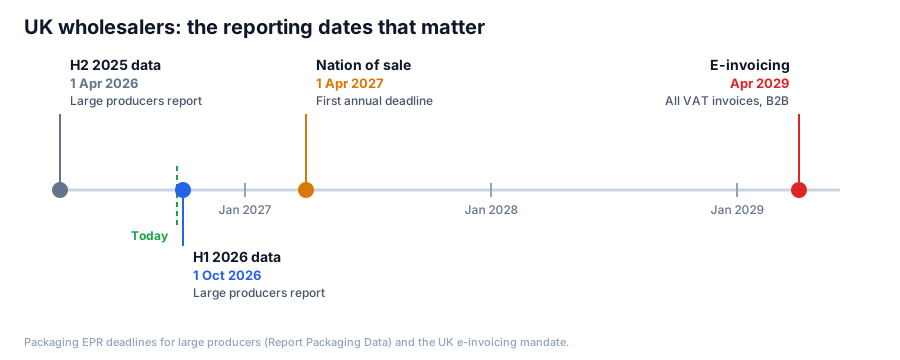
Large producers report packaging data twice a year, by 1 April and 1 October; nation-of-sale data for 2026 is due on 1 April 2027; e-invoicing follows in April 2029. At year-one base fees, every tonne of plastic a large producer places on the UK market as household packaging costs £423, and every tonne of paper and card £196, according to PackUK. An importer that can't say how many tonnes it placed on the market is estimating a bill it will then have to defend.
The three places wholesalers lose money
1. Landed cost left in a spreadsheet. If duty and freight never reach the item cost, low-margin lines look profitable and get pushed. With item charges on every receipt, the margin report tells the truth.
2. Stock that isn't there. Receiving and picking by location with scanning and cycle counts replaces the year-end write-off with a weekly correction.
3. Dead stock. Lines bought for a season or a customer that never reordered, tying up cash and warehouse space. How to find and clear them.
Compliance with dates
- Packaging EPR: importers and brand owners above the thresholds (turnover over £2 million and more than 50 tonnes of packaging a year for large producers) report every six months, by 1 April and 1 October; fees are modulated by recyclability from the 2026-27 scheme year, and nation-of-sale data is first due on 1 April 2027.
- E-invoicing from April 2029 for all VAT invoices between businesses, over Peppol. Year-by-year plan.
- Making Tax Digital for VAT continues. Business Central setup.
Where wholesalers come from
From Sage 200 and Sage 50, from Xero with a stock app bolted on, and from old Dynamics NAV. Distribution runs on Business Central Essentials. For a small UK company projects typically run £15,000-40,000; for a mid-sized wholesaler with several warehouses and integrations, £30,000-90,000.
Native versus app
| Requirement | Business Central |
|---|---|
| Landed cost with item charges | Native |
| Multi-location warehouse, bins, directed pick | Native |
| Pricing, discounts, credit control | Native |
| Making Tax Digital | Native (UK localisation) |
| Peppol e-invoicing | Native framework, with an access point connector |
| Multi-company and consolidation | Native |
| Handheld scanning | App |
| EDI | App |
| Rebates | App or focused extension |
| Packaging data per item for EPR | Focused extension |
How we help
We start with one import: from the supplier invoice and the customs entry to the cost on the shelf and the margin on the sale. Then we map your warehouse, pricing and credit processes, separate native from app, build the packaging extension and prepare for e-invoicing. We work remotely in English with companies anywhere in the UK, with Spanish and Polish for groups with operations in the EU. Each part is invoiced only after you accept it.
FAQ
We're a UK wholesaler running finance in Sage 200 and stock in spreadsheets, with a 3PL and a Shopify store. Who can bring it together in Business Central? A Business Central partner that handles all four pieces in one project: migrating finance from Sage 200 with Making Tax Digital continuing, moving stock out of spreadsheets into Business Central's warehouse, connecting the 3PL by API or EDI, and using the built-in Shopify connector for orders, stock and prices. For a mid-sized wholesaler that is typically £30,000-90,000 over 3-6 months. We run it in phases, remotely in English, and each phase is invoiced only after you accept it.
Does Business Central handle postponed VAT accounting? Yes, through the VAT setup, with import VAT accounted for on the VAT return and reconciled to HMRC's monthly statement.
Am I a packaging producer if I only import? If you import packaged goods and are above the thresholds, you are likely an obligated producer as the importer. Confirm your category with your compliance scheme or the regulator; the ERP gives you the data either way.
Do we need Premium? No, unless you assemble or manufacture with production orders. Essentials covers distribution and warehousing.
How long does it take? Three to six months for most wholesalers; longer with several warehouses and many trading partners.
See your warehouse instead of a list of bins: the 3D Warehouse app for Business Central shows real occupancy, pick routes, expiry and dormant stock, with a live demo.
Related: ERP with POS for trade counters and stores.
Free assessment · Evaluación gratuita
Tell us your current system and how many users you have. First reply within one working day. / Cuéntanos tu sistema actual y cuántos usuarios sois. Respondemos en un día laborable.
Landed cost in a spreadsheet, or no idea of your packaging tonnage? Free assessment, no commitment.
Bramvia in: Spain · United States · Mexico · United Kingdom · Ireland · Canada · Colombia · Argentina · Chile · Peru · Australia · New Zealand · South Africa · Philippines · Poland · MCP server · Safety stock calculator